After the water was unfrozen, a beach of blood, the top and the cow's taste became soft, and the fermentation of the well-coated frozen noodles was impossible.——These are the pains most often complained of when many food-suppliers and processors sought to upgrade their production lines.
These problems are not only a loss for business, but even a fatal crisis in the return of customers.
The real killer is often not fresh enough food, but the inevitable physical phenomenon in the freezing process: "the biggest crystal-generation belt".
In the competitive B2B food supply chain, the key to keeping frozen food is not "lower temperature" but "lower temperature."And if your plant is still using the traditional freezer to slow down, the loss will be not just water, but pure profit from real and silver.
What's "the biggest crystal-generating belt"? The key to keeping frozen food.
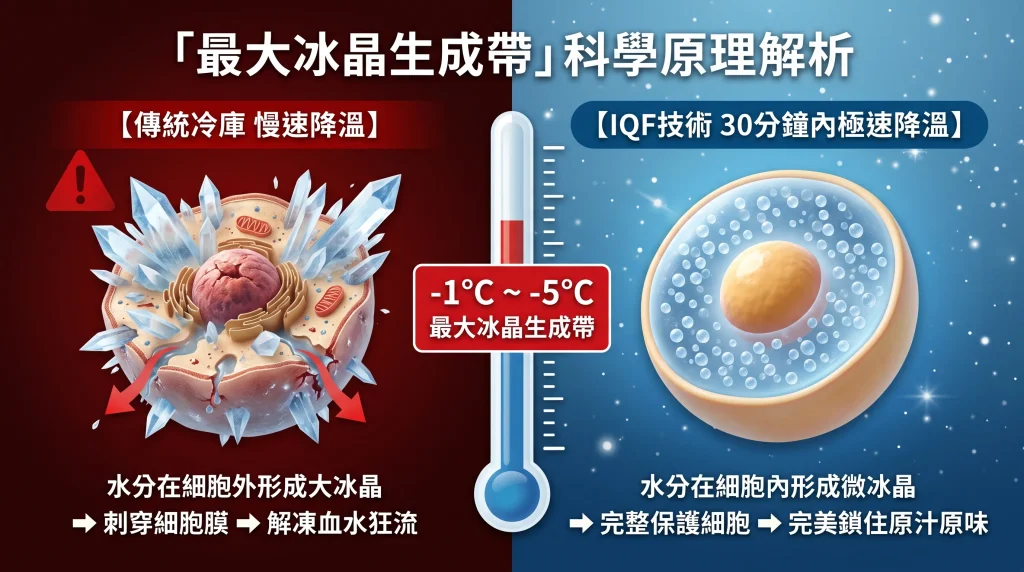
Zone of maxium ice crystal formationThe temperature is between -1°C and -5°C. 80% of the food is frozen at this stage. If the temperature cools too slowly, the water expands into a sharp "big ice crystal" that enters and cuts through the cell membranes, leading to a large loss of juice and nutrients during the defrost.
It is important to understand the differences in the technology.
We have to understand the physical changes in food at low temperatures.
The vast majority of fresh foods contain a great deal of moisture, such as meat, which is 65-80 per cent, and vegetables, which is even 90 per cent. When the food enters the freezer,The temperature drops to -1°C to -5°C.The water in the food began to condensate and to form crystals. In food science and thermodynamics, this critical temperature zone is calledMax. Ice Crystal Generation Belt。
According to the data, 80% of the water in the diet is frozen at this stage. However, water is growing by about 9%. If the temperature of the plant’s equipment is too slow, and the food is stuck at -1°C to -5°C too long, the moisture will move slowly outside the cell, gather, and eventually grow into a large, irregularly sized, and sharply edged "big crystal."
These big and sharp crystals, like hundreds of tiny bayonets, can puncture directly and sustain the fragile cell membranes of food. That's what it means.Cell damage.I don't know. Once the protective shield of the cellular membrane has been torn, when the food is unfrozen by the consumer or tourists, the disaster happens immediately.
The chain reaction of cell damage: why is the slow freezing eating your profits?
Many entrepreneurs or plant managers, while building cold-freezing banks, tend to evaluate only the number of "spaced" and "compressors' horsepower" but to use the freezers, which are generally used to "store" as "cooling", as a "cooling" that could lead to great business risks.
In the case of the Ministry of Development and Health,Battery damage directly triggers three major disasters, each of which is undermining the profits of the enterprise:
1. The growth of bacterial numbers and food risk: nightmares of product managers
The fluids that are lost are not only water, but also liquids that are abundantly nourished.
When these nutrients spill over to the food surface, they become the best hotbed for the crazy breeding of bacteria and microorganisms. If there is a small temperature wave in subsequent processing or transport, the number of bacteria (e.g., bacterium, salmonella) is extremely high. It's not only going to make it impossible for the product to be tested, it's going to be more against the U.S. FDA. HACCP Critical Control Point for Hazard Analysis andISO 222000 Food Safety Management SystemAudit of fatal risks.
2. Poor taste and darkness: loss of client trust
This is the first time that the population has been able to cope with the disease.
The meat will become wood dry, seafood will be powdered, and the produce will lose its taste.
In addition, cell damage accelerates the oxidation response, leading to the appearance of food on the surface of the US Department of Agriculture (USDA), which often warns:Freezer burn"The fact that meat is darkened and vegetables yellow leads to direct complaints from tourists."
3. Unsurprising weightlessness rate: invisible cost black holes
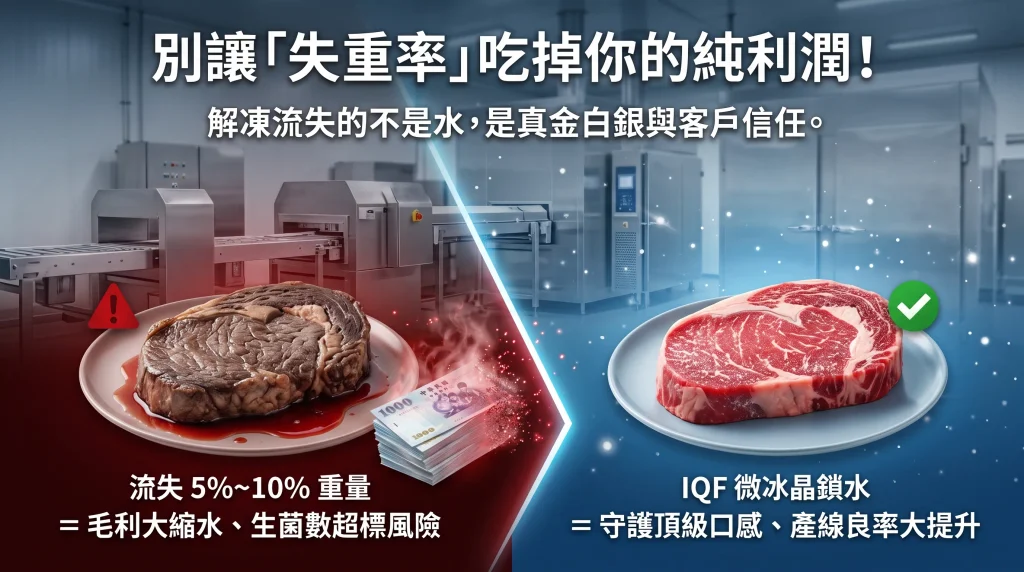
When punctured cells are unfrozen, the proteins, amino acids, vitamins and moisture in the cells are lost in large quantities by the mouth.
This is known in industry as weightlessness (or water loss).
Suppose a single-priced group of blackfish, top steak or shrimp loses 5 to 10 per cent of the frozen weight as a result of slow-frozen freezing, which means you buy a lot of raw material, and it flows straight into the drain. Reducing the weightlessness rate is a direct increase in the real Maori of the product line.
In addition to relying on the IQF's own water-locking capacity, based on 30 years of top-of-the-art experience, Ice Glazing has been able to combine the work with the work of Ice Glazing, and to further increase sales and weight. For example, the chicken leg itself, after IQF has frozen, is a very low-temperature piece of ice, and once the water is immersed for between one and two seconds, the water will freeze at once on the surface, not only to recover the weight of the food, but also to become more wet and full.
I want to know more.👉 10: How meat mills reduce the rate of cold weight loss。
Breaking myths: does the temperature go to -40°C mean it's freezing fast?
Many people often have a misunderstanding: "My freezer has been transferred to -40°C. Why does food still come out of water?"In fact, it's low temperature.。
The thickness and potential heat of the food itself can create resistance, and if the equipment lacks a strong "wind speed" and "heat exchange volume" to force the taking of heat, the temperature of the food centre will remain very slow to -1°C to -5°C, and the ice crystal will continue to be generated. The real solution is IQF technology.
The core goal of IQF (Individual Quick Freezing, Quick Freezing) is to use extreme cooling rates to force short food to stay between -1°C and -5°C (usually required) Within 30 minutes.I'm not sure. If the water doesn't come close to each other, it freezes directly into the inside of the cell, forming a small and round "microcrystal" to prevent cell damage.
I want to know more.👉 "Six: Tunnel vs Spiral Frozen Land and Production"。
| Compare | Traditional freezers | IQF, fast freezer. |
| The purpose of the design. | Temperature maintenance and long storage | The temperature drops at extreme speed and continuous line processing |
| It's made from the biggest crystal. | It takes hours to half a day. | Within 30 minutes.(depending on the thickness of the food) |
| Crystal Generation Status | The cell outside forms a large and sharp crystal. | The cells form tiny, even crystals. |
| Cell damage. | Serious damage. Cellular membrane punctured. | CompleteThe cell structure is almost intact. |
| Production hides the profit. | It's huge. It's very slow. | There's a huge increase in production.Double it at the same time. |
Four major food industries, how can they solve the pain with a top-of-the-art IQF device?
It's an example of how to control the size of the ice.
The IQF device is a perfect solution to the process of upgrading bottle necks in all walks of life:
- Aquaculture industries (black change and the union):
According to the Food and Agriculture Organization of the United Nations (FAO) Water Refrigeration Practice Guide,
Shrimp, dried beers, fish chips and other high-water-rich foods are highly susceptible to slow freezing and pasting. IQF not only keeps the meat with Q-balls, but the strong wind and vibrating designs better prevent shrimp crabs from sticking to each other on their belts, detached from each other, and more easily packaged. - Animal meat processing (locking gravy down):
Micro-ice crystals ensure the integrity of muscular fibers, locking down gravy and amino acid.
This ensures that, after the heat rises, the ready-to-preparation packs (e.g., microwave ready-to-eat foods) still have a juicy, soft taste. - Baking cold noodles (protecting yeast activity):
The tradition of freezing causes the death of crystals through yeast cells and prevents the fermentation of pasta.
IQF generation of tiny crystals allows yeasts to sleep safely and to ensure a perfect rate of inflation after baked bread. - Agricultural fruit and vegetables (steal support):
Vegetable cell walls are fragile, and traditional frozen and frozen often become slurry.
IQF is able to lock the fabric of the veggies in an instant, and keep the green velvet and the crumbs of cabbage and beans.
In addition to its strong cooling power, the roof equipment is more known as "resistance."
In addition, it is not possible to have any of the following:The most used station is now running for up to 28 years, minimizing the cost of equipment depreciation.
In the past few years, there has been a great deal of discussion about the role of "steals" and "steals".
In the case of a serious food substitute, it is important not only to listen to the propaganda of the equipment, but to have scientific proof.
Following the IQF, the P&D team can demonstrate the effectiveness of cold food preservation through two core indicators:
- Central Temperature Actual:
Using a food-grade thermometer, you can record the time the food "centre" fell from 0°C to -5°C.
If we can contain this time in 30 minutes, we can make sure in physics that only microcrystals are produced. - Drip Los Test:
It's the same batch, the same weight of food, which is frozen in traditional cold storage and IQF.
It's also set at 4°C cold storage for 24 hours. The weight of the liquid flowing from the defrozen weight of the scale.
You will find that IQF treats foods with a weightlessness rate that can be reduced significantly by more than 50%.
Top IQF Device: Preserve food taste.
To really overcome the biggest ice-crystal generation belt, the key is on the system design within the facility.
The top-tech IQF helix and tunnel-type chillers are designed for high-standard international production lines.
It has three core technological strengths:
Technology I, twirl-covered copper caps.
The top uses high-temperature plasters with copper tubes, which significantly increase the heat exchange.
Let's get the temperature down in Côte d'Ivoire and take the surface heat of the food.
Technology II, wind internal cycling system.
An exclusive streaming system produces an even and strong cold wind.
Make sure that every corner of the food can be delivered with the most rapid sprint through the dangerous temperature zone.
Technical III, full-time SUS304. No steel.
It's not made of steel, it's free of pressure and cleaning.
It's not like I'm going to be able to do anything about this.
It's a common problem with the biggest crystal-generation belt (FAQ)
Q: Does the article refer to "30 minutes" to pass through the crystal strip, which means total freezing time?
A:No, this is the period when the food "centre temperature dropped from -1°C to -5°C".
The "total freezing time" of food items (e.g. from room temperature down to -18°C) depends on the thickness and volume of the product, which usually lasts for 30 minutes. As long as the central temperature is condensed in the most dangerous "1°C to -5°C" zone, within 30 minutes, it will be able to form microcrystals and prevent cell damage.
Q: Do you need to be cold before food enters an IQF device in order to speed up the max-crystal generation belt?
A:It is suggested to pre-empt to 5°C to 10°C.
The temperature difference when the pre-cooled foods enter the fast freezer is significantly reduced. This will not only reduce the download of IQF equipment, save a great deal of energy consumption, and speed up the temperature of the food center into and across the "1°C to -5°C" period, but will further push the quality of the cold foods to the point where the whole body of the product line is being swallowed up.
Q: Can IQF be effective in preventing cell damage when food is packed?
A:The effect will be significantly reduced by recommending a standard process of "freezing first and packing later".
All packaged materials (e.g. plastic bags, vacuum bags, paper boxes) are a good insulation layer, which can seriously hinder the direct heat exchange between the cold wind and the surface of the food, leading to the increase in temperature reduction time and the creation of sharp ice crystals. The design of IQF was designed to be "a body that freezes at short speed" so that nudity can be directly exposed to the cold and then frozen and then packaged.
Q: Do IQF fast-frozen equipment consumes much more power than traditional freezers?
A:It is true that "immediate power" is higher, but it is more energy-efficient by "unit energy consumption".
Because IQF has been able to freeze in a very short period of time, it has significantly shortened the weekly period during which the compressor is fully deployed.In addition, top-tech technology is particularly effective for high energy consumption, using high-transformation "swipe-covered copper tubes" with high-transformation, and highly efficient exchange. In the long run, IQF, the top IQF, which produces an average electricity and time cost per kilogram of frozen food, is far more competitive in business than traditional cold banks.
Q: Does subsequent storage temperature waves affect quality after success in the max-crystal generation belt?
A:Absolutely, after-storage must be strictly maintained below the temperature -18°C (or lower).
If the temperature in a subsequent cold chain logistics or storage cold storage is too low (e.g., frequent door-opening), then the inside of the food will happen physically."Reconstruct the crystal.I'm sorry. The previously frozen tiny crystals will be remelted and merged to become big crystals, which will fully offset the pre-cost advantage created by IQF.
Q: What kind of food is not suitable to use IQF technology to avoid cell damage?
A:Almost all of it is fresh, but the "high-water, non-cellular wall support" large piece of food needs special evaluation.
For example, the physical structure of an entire tofu, a cow tomato or a large watermelon will change to some extent once it is unfrozen, even if it is generated at an extreme rate through the maximum crystal. For these extreme foods, it is usually suggested that the development and development of a combination of process-type changes (e.g., cedin, dredging) and a combination of IQF equipment to achieve the best quantitative standard.
Conclusion: Locking the food from the original is locking down the profits and orders of the company.
IQF fast-frozen equipment has never been just a retrofit of the hardware of the product line, but rather a tactical investment by food processing plants to improve their productivity and defend the profitability of their products. The top technology is not just providing the upper rigidity of the customer-coding system, but is more committed to being the back-up of your productivity.
We know that less than 5% of the blood and water is a 5% profit for the business.
When you have successfully locked every drop of the original taste of food through top-of-the-top IQF technology and rejected the damage caused by cell damage,It’s about locking in long-term orders and making significant gains for businesses.
I want to know more.👉 4 :2026 Guide to commercial/industrial fast-frozen equipment acquisition。

